
A new study reveals that approximately 70 per cent of the year-to-year variation in winter air pollution across northern India can be explained by the frequency of western disturbances. These storm systems, originating from the Mediterranean, help clear pollution through precipitation and ventilation. The findings suggest that predicting the frequency of these disturbances could provide advance warning of severe pollution, allowing for better preparedness and implementation of control measures.

Delhi Chief Minister Rekha Gupta announced a complete ban on construction activities from December 10 to January 20 to combat severe winter air pollution. The government will use its AI-powered Dust Portal 2.0 and AI-enabled cameras to monitor construction sites over 500 square metres in real-time, issuing alerts and fines for violations. Citizens are encouraged to report non-compliance.
The Maharashtra Pollution Control Board (MPCB) has ordered the shutdown of 19 ready mix concrete plants in the Mumbai Metropolitan Region for violating environmental guidelines and contributing to deteriorating air quality levels.

New Delhi organisers are confident of delivering a 'world-class spectacle' for the upcoming Badminton World Championships, having addressed previous concerns regarding venue cleanliness, air quality, and animal control that marred the India Open earlier this year.

The Supreme Court of India has directed the NHAI and MCD to consider relocating or temporarily closing toll plazas at Delhi's borders to alleviate traffic congestion and reduce air pollution. The court also addressed school closures and financial aid for construction workers affected by pollution control measures.

Delhi's air quality deteriorated to the 'severe' category, prompting the implementation of Stage-IV GRAP measures and hybrid classes for schools.

'It is high time to recognise that this is the greatest issue India is confronting.' 'Even the BJP should be raising concerns because polluted air suffocates everybody's child.'
Delhi government mandates 50% work from home for offices and private establishments under GRAP stage three due to severe air pollution. Essential services are exempted.

The clinics are expected to operate for at least two hours daily, particularly between September and March -- the period when air pollution levels are typically high.
Delhi Chief Minister Arvind Kejriwal on Friday said pollution levels declined in the national capital due to government initiatives as he announced a 15-point winter action plan to curb pollution.
Deepika Padukone has raised concerns about the deteriorating air quality in Mumbai, India, highlighting the impact on residents, especially children. Her comments come amid growing concerns about pollution levels in the city, which have worsened in recent years due to construction, vehicular emissions, and industrial pollution.

IIT-Kanpur Director Manindra Agrawal discusses the cloud seeding trial in Delhi, its costs, and the information gained despite the lack of rain.

The Commission for Air Quality Management (CAQM) has revoked restrictions imposed under GRAP 3 in Delhi-NCR following improvements in air quality. Non-essential construction and demolition activities are now allowed to restart, and restrictions on vehicles have been lifted.
Experts warn that air pollution in India is a major public health crisis, leading to a surge in undiagnosed airway diseases and cardiovascular issues. They urge for urgent action, early detection, and treatment.

Delhi choked under a thick blanket of smog on Monday, with the Air Quality Index (AQI) settling at 498, which falls in the higher spectrum of 'severe' category.
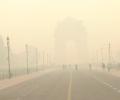
Delhi residents woke up on Tuesday to heavy grey haze darkening the city skies, reduced visibility and the air quality in the 'red zone' after many celebrated Diwali last night by bursting firecrackers beyond the two-hour limit set by the Supreme Court.

The Delhi Pollution Control Committee has issued detailed instructions to ensure the effective implementation of the ban.
In December 2016, the Supreme Court directed the central government to have a graded action plan to tackle the menace of air pollution. There are two plans - Comprehensive Action Plan and Graded Response Action Plan.
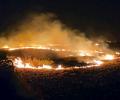
The Supreme Court has expressed concern over the increasing pollution levels during winter and has suggested that the Punjab government arrest farmers who engage in stubble burning. The court believes that this action would send a strong message and help curb air pollution.
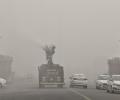
Delhi is preparing for its first artificial rain through cloud seeding to combat air pollution. A trial run was successful, and the first rainfall is expected on October 29 if weather conditions are favorable.

'If a common man wants to buy an air purifier for Rs 10,000, then he will have to shell out Rs 11,800 with 18 percent GST.' 'If he is charged GST at 5 percent the same air purifier will cost Rs 10,500.' 'This saves a one time amount of Rs 1,300 -- and that too just to breathe clean air.'

This has been our history of good governance: Things that were difficult to do and required planning and implementation were first taken up and then abandoned, notes Aaakr Patel.

The first cloud-seeding trial has been conducted in parts of Delhi, including Burari and Karol Bagh areas, aimed at inducing artificial rain to tackle air pollution.

The Supreme Court on Wednesday rapped the Haryana and Punjab governments over non-prosecution of violators found guilty of stubble burning and summoned the state chief secretaries to appear before it on October 23 and submit. an explanation.

Delhi recorded its coldest January morning in three years with the minimum temperature dropping to 3 degrees Celsius. Cold wave conditions are expected to persist, and air quality has deteriorated to the 'very poor' category.

'We will need to review the scheduling of matches between 15 December to 15 January in north India.'
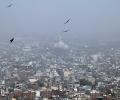
IMD Director General Mrutyunjay Mohapatra said that inducing artificial rain can only be attempted when there are clouds or moisture available.

Interest in green living is rising, with clean air and open spaces becoming key selling points for residential projects, particularly as Indian cities struggle with deteriorating air quality.
Delhi's 24-hour average air quality index (AQI) stood at 248 on Saturday.

Preventive measures are in place and the forecast suggests further improvement, said the statutory body responsible for forming air pollution reduction strategies for the region and their implementation.

'If you keep on irritating the body by allowing all kinds of pollutants to get into it, the body cells are going to get irritated and cancer will come.'

Delhi's air quality plummeted to alarming levels on Tuesday after 24 days, with many areas witnessing a significant spike in pollution despite the strictest measures, including a ban on construction activities and the entry of trucks into the city, coming into force.

The city's air quality dropped to the "very poor" category, with an Air Quality Index of 330 at 10 pm.
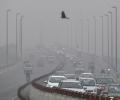
With Delhi recording air pollution levels seven to eight times above safe standards on Monday, the city government announced the return of its flagship odd-even scheme after four years anticipating further deterioration of air quality post-Diwali.

Under the emergency plan, stringent actions are implemented based on the air quality of the city.

As visibility remained poor and the city choked due to a haze, the Centre for Science and Environment asked the Delhi govt to roll out stringent plans for controlling winter pollution.
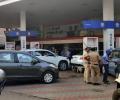
The Delhi government has announced that vehicles older than 15 years will be denied fuel at petrol pumps starting April 1.

Air quality index (AQI) soared past 350 level in parts of Delhi on Thursday and experts cautioned that as weather turns colder it may breach the 400-mark ceiling and enter the 'severe' zone soon, notwithstanding the incidents of stubble burnings which have nosedived from 17,529 in 2020 to 4,262 this year.

The city's Air Quality Index (AQI) stood at 420 at 8 am on Thursday, compared to 426 at 4 pm on Wednesday. The AQI map prepared by the Central Pollution Control Board showed clusters of red dots (indicating hazardous air quality) spread across the Indo-Gangetic plains.
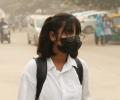
'Pollution acts as an endocrine disruptor.' 'When it acts as an endocrine disruptor it has an effect on the endocrine system of the human body and the effect on the pancreas is an important one.' 'The way you get type two diabetes is due to two defects.' 'One is the pancreas doesn't produce enough insulin.' 'The other physiological defect is insulin resistance.'
